
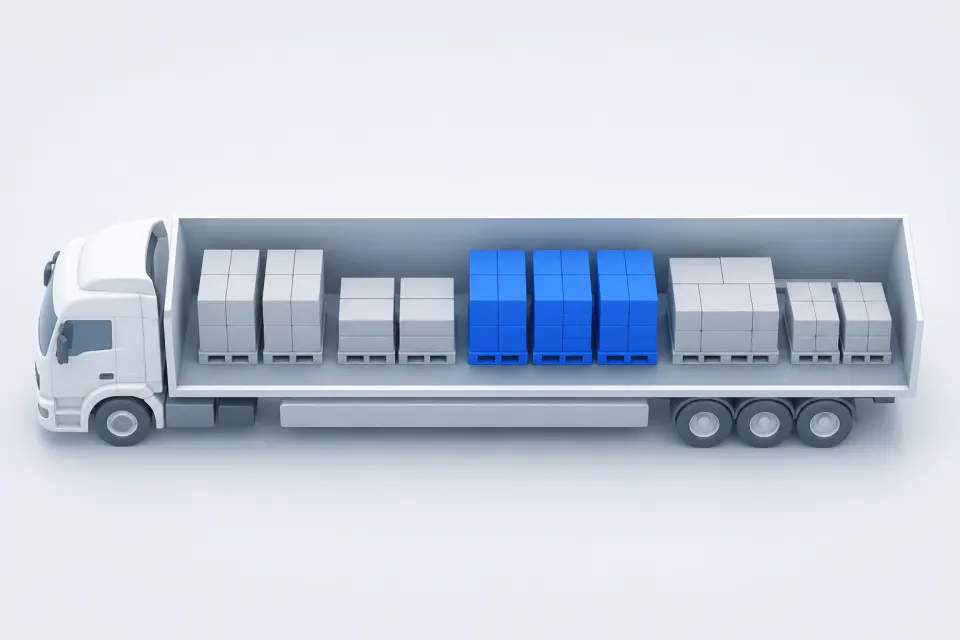
Groupage versus a full load
In a full load (FTL, full truckload, or FCL, full container load) the shipper hires the whole trailer or container and pays for it regardless of how much space the cargo really takes. The vehicle runs from one loading point to one unloading point, and nobody touches the cargo on the way.
In groupage (LTL or LCL) consignments from several shippers share one trailer or container. Cargo is first collected from suppliers, then consolidated, that is, loaded together into one vehicle, and split again between consignees in the destination country. Each shipper pays for its own share: loading metres, weight or cubic metres. That is why groupage is the standard way to move one or a few pallets without paying for a whole truck.
The lower price of groupage is paid for in time and handling. The consignment waits for consolidation, the truck stops at several shippers and consignees on the way, and the pallet is moved by forklift more than once. A full load runs direct and faster, but you pay for the whole trailer even if it carries two pallets. So the choice depends on volume, deadline and how well the goods tolerate handling.
When groupage is the better deal
The line is drawn by floor length and weight. Up to about 5 LDM, that is up to 12 EUR pallets that are not stacked, groupage is almost always cheaper than a dedicated truck. From 5 to 10 LDM you are in part-load territory: such cargo often travels in the same truck without transhipment, and it is worth comparing the price with a full load. Above 10 LDM or 18 tonnes a full truck usually wins, and for that there is exw.lv.
Groupage also pays when you order often and in small batches: less cash is tied up in stock, and there is no waiting until a full truckload builds up. You can test your own case in the freight calculator: it shows LDM, chargeable weight and the share of the trailer you take.
How the price is calculated
By road the price follows loading metres (LDM): how many metres of trailer length the cargo takes across the full 2.4 m width. A 120×80 cm EUR pallet is 0.4 LDM, a 120×100 cm pallet is 0.5 LDM. Chargeable weight is the greatest of three figures: actual weight, LDM × 1,750 kg and m³ × 333 kg. For light, bulky cargo the floor decides; for heavy cargo the weight does.
Sea LCL is charged in W/M units: one unit is 1 m³ or 1,000 kg, whichever is greater, with a minimum of one. In air freight 1 m³ counts as 167 kg, so volumetric weight is length × width × height in centimetres divided by 6,000. By rail the price is per cubic metre or per kilogram depending on cargo density. For every mode the price also depends on the pickup address, a tail lift for delivery, the ADR class and temperature control.
What drives transit time
As a guide: road takes 2-5 days from Poland, Germany, the Netherlands and Finland and 4-10 days from Italy, France and Spain, air 2-5 days, rail from China 14-20 days and sea from Asia 25-45 days. Groupage adds consolidation time on top: the consignment waits until enough cargo builds up on the same lane. On regular routes that is a few days; on rare ones it can take longer.
Transit time also depends on transhipment at terminals, customs clearance for cargo from outside the EU, incomplete documents and supplier readiness. The most common cause of delay is cargo that is not ready or not packed on the agreed day. Regular lanes and their transit times are in the list of routes.
How to prepare the cargo
Groupage is handled several times on the way, so the packaging has to survive repeated loading. Place the goods on the pallet without overhang, secure them with stretch film or straps, and label every piece with the consignee and the piece count. Mark fragile and non-stackable cargo in your request as well: it changes the floor space taken and the price.
Give exact dimensions and weight, including the pallet. If the real cargo turns out bigger, we reprice it, and the space on the truck may not be held. Dangerous goods (ADR) and temperature-controlled cargo are carried by prior agreement, so tell us about them in advance.
Which documents you need
Within the European Union an invoice, a packing list and a CMR consignment note filled in at loading are enough. Excise goods such as wine moving under duty suspension also need an electronic administrative document, the e-AD. For cargo from outside the EU the importer needs an EORI number and the goods must clear customs: the declaration needs the invoice, the packing list and the transport document - a bill of lading (B/L) at sea, an air waybill (AWB) by air or a rail consignment note.
Who arranges the transport and who pays for customs is set by the Incoterms rule in your contract with the supplier. Under EXW or FCA the buyer arranges carriage; under CIF or DAP the seller does. The rules are explained in plain language on incoterms.lv. We include customs clearance and door delivery in the quote.
Glossary
- LTL / FTL
- Less than truckload and full truckload: shared and dedicated road freight.
- LCL / FCL
- Less than container load and full container load: a shared container or a whole container for one shipper.
- LDM
- Loading metre: one metre of trailer length across its full width. A standard trailer holds 13.6 LDM.
- W/M
- Weight or measurement: the sea LCL billing unit, 1 tonne or 1 m³, whichever is greater.
- Chargeable weight
- The weight the price is based on: the greater of actual and volumetric weight.
- CFS
- Container freight station: the terminal where groupage is loaded into and unloaded from containers.
- CMR
- The international road consignment note. The CMR Convention limits carrier liability to 8.33 SDR per kilogram.
- AWB
- Air waybill: the contract of carriage and transport document for air cargo.
- B/L
- Bill of lading: the sea transport document that confirms receipt of the cargo and title to it.
- EORI
- A company's EU customs registration number. Without it you cannot import goods from outside the EU.
- Incoterms
- International delivery rules (EXW, FCA, FOB, CIF, DAP and others) that split costs and risks between seller and buyer.
- e-AD
- Electronic administrative document for moving excise goods within the EU.
Calculate or request a price
Check your cargo in the calculator or send a request: we prepare a quote within 1 hour during business hours.